

Paper or plastic? It sounds like a simple packaging decision, but for F&B businesses, the answer is rarely that straightforward.
A café serving takeaway coffee has very different needs from a restaurant packing curry, a dessert shop selling cold treats, or a cloud kitchen preparing meals for delivery. The right packaging needs to protect the food, suit the temperature, travel well and remain practical for daily operations.
That is why comparing paper vs plastic packaging is less about finding one universal winner and more about understanding where each material works best.
| Factor | Paper Packaging | Plastic Packaging |
|---|---|---|
| Presentation | Natural, clean and suitable for paper-led branding | Practical, with clear options that can showcase the food |
| Moisture Handling | Depends on the product and coating | Generally strong with suitable food containers |
| Leak Resistance | Depends heavily on container and lid design | Often well suited to secure containment |
| Hot Food | Many formats are designed for hot meals and drinks | Depends on the plastic type and intended application |
| Food Visibility | Usually opaque | Clear containers can display the contents |
| Branding | Strong potential for printed packaging | Available for selected products |
| Storage | Varies by product format | Varies by container design and shape |
| Sustainability | Paper-based options may reduce reliance on conventional plastic | Depends on material, reuse, recyclability and disposal |
| Common Uses | Cups, bowls, trays and lunch boxes | Cups, food containers, lids and takeaway packaging |
Where Paper Food Packaging Works Well
Paper packaging is commonly used across cafés, restaurants and takeaway businesses because it can cover several different food and beverage applications.
Products such as paper cups, bowls, trays and kraft lunch boxes can work well for:
- coffee and tea
- rice meals
- noodles
- pasta
- bakery items
- snacks
- takeaway meals
Paper packaging also has a distinctive appearance. Kraft and white paper formats can support businesses that want a clean, simple or more natural-looking presentation.
Custom printing can further turn cups and other suitable packaging into part of the customer experience, especially for cafés and beverage brands where the packaging remains visible after the order leaves the counter.
However, not every paper package performs the same way. Coatings, construction, lid compatibility and the type of food being packed all matter.
For example, a paper tray that works well for fried snacks would not necessarily be the right choice for a saucy noodle dish.
Where Plastic Food Packaging Works Well
Plastic remains useful in many F&B operations because it can offer strong containment, visibility and convenience when the correct type of container is selected.
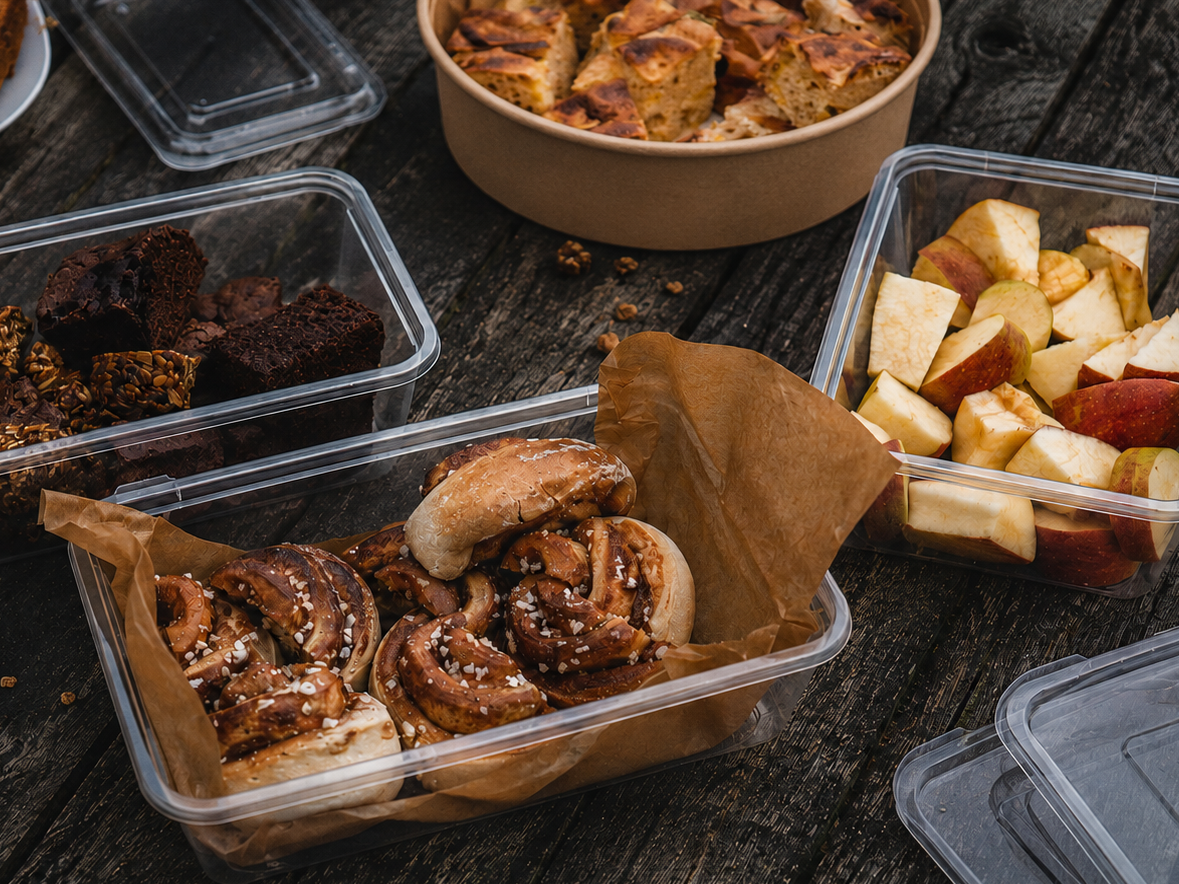
Clear plastic food containers are particularly useful when businesses want customers to see the food before opening it.
That can be valuable for:
- salads
- desserts
- prepared meals
- side dishes
- cold food
- grab-and-go products
Plastic containers can also be practical for foods where moisture, sauces or secure closure are important.
The important point is that not all plastics are designed for the same application. Businesses should use packaging intended for food contact and appropriate for the temperature and type of food being served.
The Differences That Matter Most for F&B Businesses
Heat and Temperature
Temperature is one of the first things to consider when choosing food packaging.
Paper packaging is commonly used for hot drinks and meals, but the exact product still needs to suit the application. For example, a paper cup designed for coffee has different requirements from a paper tray intended for snacks.
Plastic packaging also varies significantly. Some food containers are designed for particular temperature ranges, while others may be intended mainly for cold or room-temperature products.
Instead of choosing based purely on material, ask yourself: What temperature will the food be when it enters the container, and how long will it stay there?
Moisture, Sauces and Grease
Packaging that works perfectly for dry food may struggle with soup, curry or oily dishes.
Paper products often rely on their construction or protective coating to handle moisture and grease effectively.
Plastic containers can provide strong moisture resistance, which can make them useful for certain saucy or wet foods.
However, container shape and lid fit matter just as much as material.
A poorly matched lid can turn even a suitable container into a delivery problem.
Leak Resistance and Delivery
Food delivery puts packaging under more pressure than dine-in service.
Containers may be:
- stacked
- placed inside delivery bags
- tilted during transport
- carried over uneven roads
- left packed for longer periods
For this reason, businesses should evaluate the complete packaging system, not only the container.
That means considering the container, lid, food consistency and the delivery journey.
Some paper bowls with suitable lids may work perfectly for certain meals, while a plastic food container may be better for another.
The right choice depends on how the packaging performs in actual service.
Food Presentation
Presentation matters even when the meal is delivered. Paper packaging can create a clean and simple appearance that works particularly well for cafés, bakeries, takeaway concepts and brands with a paper-led visual identity.
Plastic packaging has a different advantage; visibility. A clear container allows customers to see the food immediately, which can be useful for colourful salads, desserts, prepared meals and display items.
Neither approach is automatically better. The question is whether the packaging complements the food and the brand experience you want to create.
Branding
Packaging can continue promoting a business long after the customer leaves the counter. Paper packaging often lends itself naturally to printed designs, logos, brand colours and promotional messages.
For cafés and beverage businesses, a custom printed cup can become a highly visible part of the takeaway experience.
Plastic packaging can also support branding depending on the format, although businesses may use labels, stickers, sleeves or other branding elements instead.
When choosing packaging, consider whether branding is essential to the experience, useful but optional, or simply unnecessary for that particular item. Not every container needs to become an advertisement.
Cost
Paper versus plastic should not be compared purely by looking at the price of one container. Businesses should consider the total packaging setup.
This can include:
- container price
- lid
- sleeve
- stickers or labels
- additional bags
- storage space
- wasted packaging
- damaged or leaking orders
A cheaper container may not actually reduce costs if it regularly requires additional packaging or does not suit the food properly.
For businesses processing hundreds of orders, these small differences can become significant over time.
Storage and Daily Handling
Packaging also needs to work behind the counter.
Consider:
- how much storage space cartons require
- how quickly staff can pack orders
- whether lids and containers are easy to match
- how many different sizes the business needs
- whether several menu items can share the same packaging
Simplifying the packaging range can sometimes be more valuable than choosing the lowest-cost option for every individual product.
Sustainability Is More Complicated Than Paper vs Plastic
One common assumption is that paper automatically means environmentally friendly while plastic automatically means unsustainable. In practice, packaging decisions are more complicated.
Factors such as material sourcing, coatings, recycling availability, contamination from food, disposal methods and the amount of packaging used all affect the overall impact.
There is also a practical consideration. If a poorly chosen package leaks and the meal needs to be replaced, the business may waste food, packaging and delivery resources.
That is why sustainable packaging should still perform its basic job properly.
Instead of focusing only on the material, businesses can also reduce waste by:
- avoiding oversized containers
- removing unnecessary layers
- using fewer packaging formats where practical
- supplying disposable accessories only when required
- selecting packaging that consistently protects the product
For businesses specifically exploring greener options, see our guide for the best eco-friendly packaging options.
Which One Should Your Business Choose?
There is no need for every F&B business to commit entirely to paper or entirely to plastic.
A more practical approach is to start with the application.
| Business Need | Good Starting Point |
|---|---|
| Takeaway coffee or tea | Paper cup |
| Rice meals and takeaway boxes | Paper lunch box or bowl |
| Food where presentation through the container matters | Clear plastic container |
| Cold desserts or grab-and-go products | Plastic container |
| Snacks and lighter food | Paper tray |
| Saucy or moist dishes | Depends on container and lid |
| Delivery where secure closure is important | Choose based on full container-and-lid performance |
| Large menu with different food types | Combination of paper and plastic |
The key word here is starting point. Actual suitability still depends on the product specification and the food being packed.
Using Paper and Plastic Together Can Make More Sense
For many Malaysian F&B businesses, a combination of packaging materials will be the most practical solution. Consider a café that serves both food and drinks.
It might use:
- paper cups for hot coffee
- plastic cups for selected cold beverages
- kraft lunch boxes for takeaway meals
- paper trays for pastries
- plastic containers for foods where visibility or moisture resistance matters
- appropriate lids for each application
That is not inconsistent. It simply means the packaging has been selected around the menu rather than around one material.
A restaurant may follow a similar approach. Dry meals could go into paper-based packaging, while particular sauces, sides or desserts may be better suited to another container format.
The objective should be to build a packaging system that makes sense as a whole.
Choosing Food Packaging for Your F&B Operation
Before ordering packaging, it helps to review the menu item by item.
Consider and think hard on questions like:
What are you serving?
Dry, oily, saucy, hot, cold or liquid?
How will customers receive it?
Dine-in, takeaway, delivery or grab-and-go?
How long will it stay inside the container?
A five-minute takeaway order is different from a longer delivery journey.
Does presentation matter?
Would customers benefit from seeing the food, or is a branded paper package more suitable?
How frequently will we reorder?
High-volume businesses may benefit from simplifying packaging sizes and maintaining dependable stock.
LCCS Food Packaging supplies both paper and plastic packaging options for Malaysian F&B businesses, allowing operators to choose packaging around their actual menu requirements.
Relevant options include paper bowls, trays, lunch boxes and cups alongside plastic food containers and beverage cups.
The goal is not necessarily to replace one material with another. It is to choose the appropriate format for each part of the operation.
Paper or Plastic? Start With the Food
When comparing paper vs plastic food packaging, neither material is universally better for every F&B business.
Paper packaging can offer practical takeaway formats, strong branding opportunities and a distinctive presentation. Plastic packaging can provide advantages in areas such as visibility, moisture handling and secure containment when the correct product is used.
For many businesses, the best solution will be a combination of both.
Instead of asking:
“Should we use paper or plastic?”
A more useful question is:
“Which packaging works best for this food, this customer and this delivery journey?”
Once that is clear, choosing the right food packaging becomes much easier.